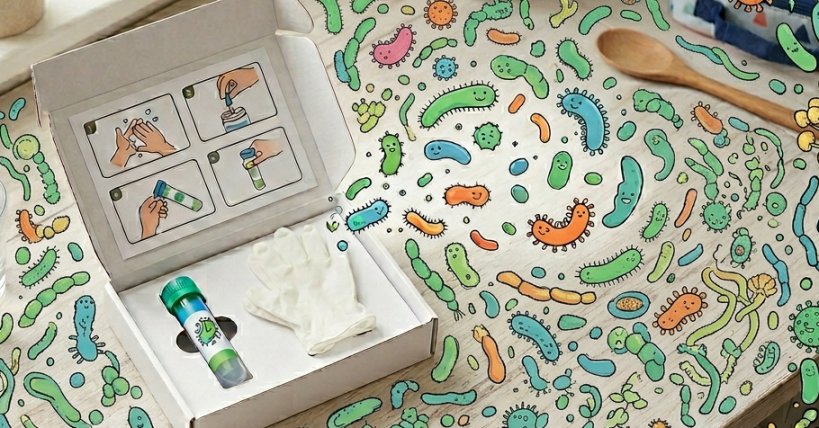
If you've ever wondered whether your child's gut is playing a role in what they're struggling with — behaviour, focus, sleep, or digestive discomfort — the gut microbiome test is one of the most direct ways to find out. Not by elimination or guesswork, but by looking directly at what's happening inside the gut itself.
It's a stool test that analyses the thousands of microorganisms living in your child's digestive tract, while also assessing digestive function, the presence of inflammation, and the integrity of the gut lining. It provides one of the most comprehensive views of gut health available — and in the context of Autism and ADHD, what it reveals is often profoundly useful.
The gut is at once a digestive organ, a key part of the immune system, and — through the gut–brain axis — a central player in mood, behaviour, and neurological function. The comprehensive gut microbiome test reflects all of these dimensions at once.
The ratio of beneficial to harmful bacteria, the presence of yeast such as Candida, and any parasites. Dysbiosis — an imbalanced microbiome — is significantly more common in children with Autism than in the general population, and has a direct influence on behaviour and mood.
Digestive enzyme activity, how effectively nutrients are being absorbed, and whether fats are being broken down properly. These markers reveal whether a child's body is actually benefiting from the food they eat — or whether nutrients are passing through without being used.
Markers of gut lining irritation and immune activation — including calprotectin and secretory IgA. Chronic gut inflammation is prevalent in children with Autism and contributes to the broader inflammatory burden that reaches the brain.
The integrity of the gut lining — whether it is intact or has become too porous. When the gut barrier is compromised, food particles, toxins, and bacteria can pass into the bloodstream, triggering systemic inflammation with neurological effects.
Gut inflammation and dysbiosis can produce symptoms that look entirely neurological — irritability, mood instability, difficulty concentrating — even in children with no obvious digestive complaints. The gut microbiome test can surface these hidden connections.
Research consistently shows that children with Autism have significantly different gut microbiome compositions compared with neurotypical peers. Specifically, higher levels of bacteria such as Clostridia and Desulfovibrio are commonly found alongside lower levels of beneficial strains like Bifidobacterium and Lactobacillus. This imbalance is not simply a digestive issue: harmful bacteria produce metabolites that disrupt neurotransmitter function — affecting both dopamine and serotonin — with measurable downstream effects on behaviour.
Increased intestinal permeability is also highly prevalent in this group. A compromised gut barrier allows undigested proteins — including those from gluten and casein — to enter the bloodstream, where they trigger an immune response and inflammation that reaches the brain. The connection we describe in our article on the gut–brain axis doesn't begin in the brain. It begins here.
Unlike a general blood panel or the Organic Acid Test — which reads metabolic traces in urine — the gut microbiome test analyses the contents of the gut directly. Key markers assessed include:
The collection process is entirely painless for the child and takes place at home — no clinic visit required.
Prepare. Depending on the laboratory, probiotics or certain medications may need to be paused for a few days before collection to ensure the results aren't skewed. Specific instructions will come with the test kit.
Collect at home. A stool sample is collected using the provided kit. The process is straightforward and requires only a parent's assistance — no special preparation from the child.
Send to the lab. The sample is sent to a specialist laboratory where it is analysed using advanced DNA sequencing technology — a method capable of identifying microorganisms that standard culture-based testing would miss entirely.
Review the results. Results are typically available within two to four weeks. The report contains hundreds of data points — interpreting them meaningfully requires a practitioner who can read the findings in the context of the specific child and translate them into targeted next steps.
These two tests complement each other — each sees a different part of the picture.
The Organic Acid Test shows the metabolic footprint that microorganisms leave across the whole body — like reading their reflection. The gut microbiome test goes directly to the source: it looks at who is living in the gut and how the environment they're operating in is functioning. For children with more complex presentations, or where the OAT has suggested significant dysbiosis, both tests together provide the most complete picture available.
The gut microbiome test is one of the tools we use when we want to understand a child's gut in depth — whether because of persistent digestive symptoms, unexplained behavioural patterns, or because earlier testing has pointed toward gut imbalance without fully answering the question. What it reveals directly shapes the support we then build around that child.
We value your privacy
Essential cookies keep this website working. With your permission, we also use Google Analytics to measure how the site is used. You can change your choice at any time using "Cookie settings" in the footer.